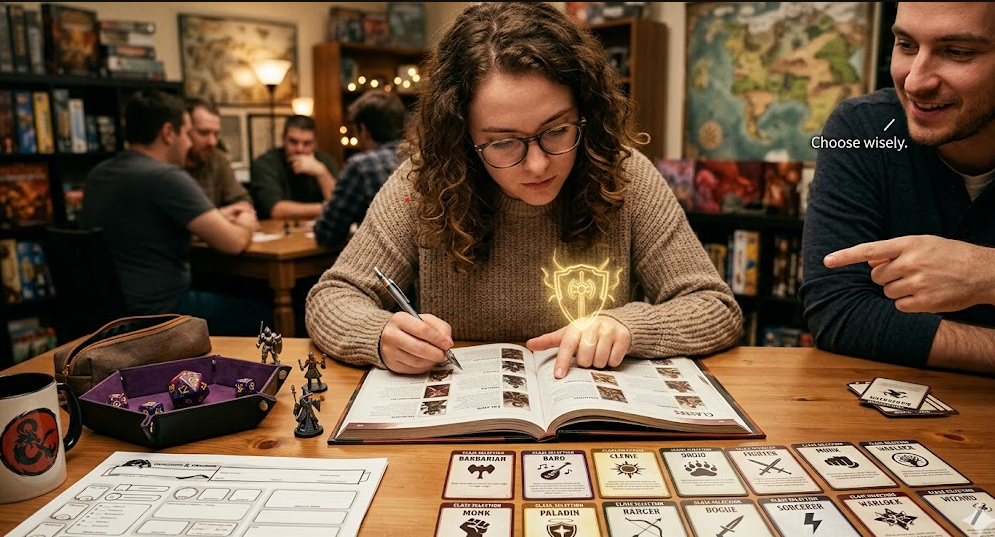

Dungeons & Dragons (D&D) isn’t just about rolling dice and crunching numbers; it’s really about weaving stories together as a group. At the core of every epic adventure is the Player Character (PC). Your character serves as your personal avatar in a fantastical realm, allowing you to engage with dragons, strike deals with kings, and navigate perilous dungeons.
While diving into a 300-page Player’s Handbook might feel overwhelming, crafting your first character is actually a straightforward, step-by-step journey. Picture it as creating a person from the ground up: you start with their essence (personality), then shape their physical traits (race and class), and finally, you add the stats that showcase their skills and abilities.

Step 1: The Concept (The “Who”)
Before you even pick up a pencil, take a moment to ask yourself:
Who do I want to be?
You don’t have to write a lengthy backstory, but you definitely need a captivating hook. Do you envision yourself as the stoic protector? Or perhaps the clever trickster who can charm their way out of any situation? Maybe you see yourself as the scholarly wizard on a quest for forbidden knowledge?
Here’s a little tip: Start with a familiar trope and then put your own spin on it. A “Knight in Shining Armor” is a timeless classic, but how about a “Knight who has an irrational fear of spiders”? Now that’s a character with plenty of potential for growth!
Step 2: Choose Your Race
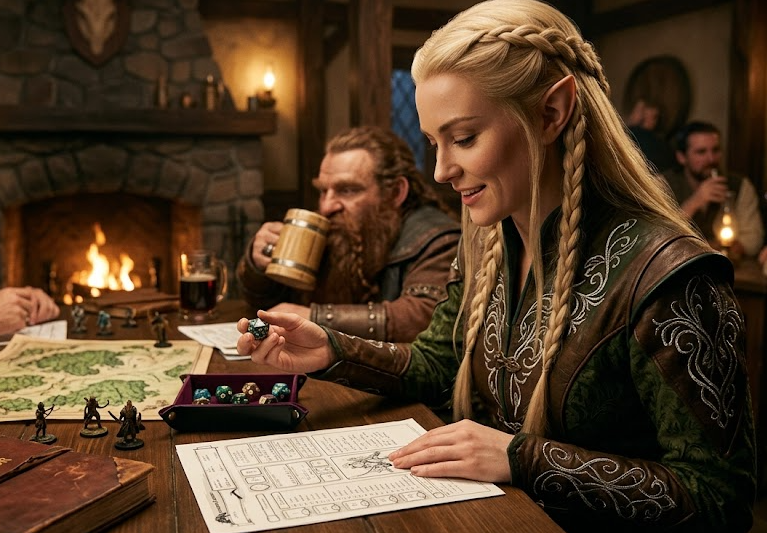
In D&D, “Race” represents your species. This choice provides your character with innate abilities, such as the ability to see in the dark (Darkvision) or resistance to certain types of damage. Here’s some beginner friendly recommendations:
| Race Group | Common Examples | Notable Traits | Best For… |
| Common | Human, Elf, Dwarf, Halfling | Versatility, Darkvision, Resilience. | Any Class / Classic Fantasy. |
| Planar | Aasimar, Tiefling, Genasi | Resistance to energy (Fire/Radiant), innate spells. | Paladins, Warlocks, Sorcerers. |
| Beast-Folk | Tabaxi, Tortle, Lizardfolk | High mobility, natural armor, or claws. | Monks, Rangers, Barbarians. |
| Monstrous | Goblin, Hobgoblin, Orc | Bonus action escapes, tactical buffs, raw power. | Rogues, Fighters, Artificers. |
| Fey | Fairy, Harengon, Satyr | Flight, high initiative, magic resistance. | Bards, Druids, Wizards. |
| Unique | Warforged, Changeling | Constructed bodies (AC bonus), shapeshifting. | Fighters, Rogues (Infiltration). |
Detailed Breakdown of Popular Races
| Race | Key Feature | Description |
| Dragonborn | Breath Weapon | Exhale a 15ft cone of fire, frost, or lightning based on your color. |
| Tiefling | Infernal Legacy | You know the Thaumaturgy cantrip and gain fire resistance. |
| Tabaxi | Feline Agility | You can double your movement speed for a turn to sprint across the map. |
| Warforged | Integrated Protection | You are a sentient construct; you gain a +1 bonus to your Armor Class. |
| Aasimar | Celestial Revelation | You can sprout spectral wings or emit light to deal extra radiant damage. |
| Goliath | Stone’s Endurance | You can use a reaction to shrug off damage, making you incredibly tanky. |
| Changeling | Shapechanger | You can change your physical appearance at will to look like any humanoid. |
| Gnome | Gnome Cunning | You have Advantage on all Intelligence, Wisdom, and Charisma saves vs magic. |
Keep In Mind: Your race isn’t just a simple stat block; it shapes how the world perceives and interacts with you. For instance, an Elf might be welcomed with grace and respect in the grand halls of nobility, while a Tiefling, with their demonic heritage, could encounter unwarranted distrust in a quaint village.
Step 3: Choose Your Class
Your Class is essentially your profession and the main way you contribute to the “party” (that’s your group of players). It shapes how you fight and the unique abilities you bring to the table.
The Martial Powerhouses: Think of classes like the Barbarian, Fighter, and Monk. These guys are all about physical strength, weapon skills, and sheer stamina.
The Spellcasters: On the flip side, we have Wizards, Sorcerers, and Warlocks who tap into the arcane arts. They can deal out some serious damage, but watch out—they often have “glass cannon” builds, meaning they hit hard but can go down easily.
The Support & Utility: Then there are the Clerics and Druids, who are the backbone of the party, keeping everyone alive. Bards and Rogues shine in areas like lockpicking, persuasion, and manipulating the battlefield to their advantage.
Step 4: Determine Ability Scores
Now we’re diving into the fun part of the RPG! Every character has six essential stats that shape their physical and mental capabilities:
– Strength (STR):
This measures your character’s natural athleticism and physical power, which is crucial for Fighters. – Dexterity (DEX): This reflects agility, reflexes, and balance, making it key for Rogues.
– Constitution (CON):
This represents endurance, health, and overall vitality, important for everyone. – Intelligence (INT): This gauges mental sharpness, memory, and analytical skills, vital for Wizards.
– Wisdom (WIS):
This covers intuition, perception, and insight, which are essential for Clerics.
– Charisma (CHA):
This indicates confidence, eloquence, and leadership abilities, important for Bards and Paladins.
How to get your numbers: Most newcomers opt for the Standard Array: {15, 14, 13, 12, 10, 8}. You’ll assign these numbers to your stats, placing your 15 in the most critical stat for your class and your 8 in the “dump stat”—the area where your character struggles the most.
Step 5: The Numbers – Modifiers and Proficiency
Now that you’ve got your scores, it’s time to figure out your Modifiers. These are the numbers you’ll actually add to your d20 rolls.
Let’s break it down: A score of 10 is considered average (+0). For every 2 points above that, you get an extra +1. Conversely, for every 2 points below, you subtract -1.
For instance, if your Strength is 16, you’ll have a +3 modifier.
Don’t forget about your Proficiency Bonus, which starts at +2 when you hit Level 1. This bonus applies to any skills your character is specifically trained in, like “Athletics” or “Stealth.”
Step 7: Equipment and Armor Class (AC)
Your class and background will give you starting gear. One of the most important numbers on your sheet is your Armor Class (AC). This is the number an enemy must roll to successfully hit you.
- Heavy Armor: High AC, but makes you loud and clunky.
- Light Armor: Lower AC, but allows you to add your high Dexterity modifier to your protection.
Don’t forget your Hit Points (HP)! Your starting HP is usually your Class’s Hit Die (e.g., 10 for a Fighter) plus your Constitution modifier.